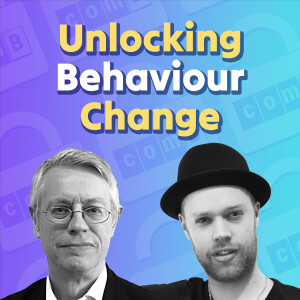
Unlocking Behaviour Change
Unlocking Behaviour Change is a podcast delving into psychology and motivation. Join Professor Robert West, a world-leading behavioural scientist, and Jamie West, a writer and musician, as they explore the human mind with practical insights and a touch of humour. Whether you’re into psychology, behaviour science, or just want to understand yourself (and others) a little better, this podcast is for you. Check out our latest books: Energise: The Secrets Of Motivation: https://shorturl.at/bbA7y React: Harness Your Animal Brain: https://shorturl.at/yiFQ9 Sign up to Robert’s Substack: https://robertwest100.substack.com/ Subscribe to the UBC YouTube channel: https://www.youtube.com/@unlockingbehaviourchange








Episodes
5 days ago
5 days ago
26 min
Robert has been to China with Susan (Michie) to launch the Chinese translation of the Behaviour Change Wheel book. Robert waxes lyrical about what a wonderful time he had and how smart, fun, and kind his hosts were, and how modern, clean, and efficient everything was ...
Meanwhile, in what's left of the episode ... Robert and Jamie discuss how to think about ‘active communication’ when it comes to changing behaviour: the point being that there's a whole lot of work to do in communication before you can deliver behaviour change techniques: grabbing attention, ensuring that people get the message, getting people to believe the message, then getting them to remember it when required, and last but not least, getting them to act on it. There's a lot of science behind all of these.
When it comes to changing people's minds, Robert refers to a Substack article on how this is rather like trying to get a Large Language Model not to hallucinate. Here's a link to it.
Want more? Check out our latest books:
Energise: The Secrets Of Motivation: https://shorturl.at/bbA7y
React: Harness Your Animal Brain: https://shorturl.at/yiFQ9
Sign up to Robert’s Substack: https://robertwest100.substack.com/
Subscribe to the UBC YouTube channel: https://www.youtube.com/@unlockingbehaviourchange
Ask a question at: https://www.unlockingbehaviourchange.com
Oct 13, 2026
Oct 13, 2026
26 min
In the previous episode, Robert castigated economics and economists' concept of 'utility' as fundamentally flawed, leading to models whose predictions keep being wrong. This week, Robert sketches out a way of thinking about utility that could improve economic modelling, yield more accurate predictions, and provide a more rational basis for macro-economic policy. A bold claim ... but this is a podcast, not an academic paper!
Want more? Check out our latest books:
Energise: The Secrets Of Motivation: https://shorturl.at/bbA7y
React: Harness Your Animal Brain: https://shorturl.at/yiFQ9
Sign up to Robert’s Substack: https://robertwest100.substack.com/
Subscribe to the UBC YouTube channel: https://www.youtube.com/@unlockingbehaviourchange
Ask a question at: https://www.unlockingbehaviourchange.com
Oct 6, 2026
Oct 6, 2026
28 min
Robert has a bone to pick with economic theory . . . In fact, he wants to pick its bones clean and start over with a much better theory for everyone! Join the duo as they discuss what economic theory gets wrong and how it might be put right . . .
Want more? Check out our latest books:
Energise: The Secrets Of Motivation: https://shorturl.at/bbA7y
React: Harness Your Animal Brain: https://shorturl.at/yiFQ9
Sign up to Robert’s Substack: https://robertwest100.substack.com/
Subscribe to the UBC YouTube channel: https://www.youtube.com/@unlockingbehaviourchange
Ask a question at: https://www.unlockingbehaviourchange.com
Sep 29, 2026
Sep 29, 2026
24 min
Derisory amounts of money paid for a piece of work called an 'honorarium' seem ok when if they were a 'fee', it would be insulting! Robert and Jamie discuss how we react differently to the same things when they are classified and labelled differently. This includes clinical diagnoses, where receiving a 'diagnosis' can be a huge relief to sufferers but can also carry stigma.
Want more? Check out our latest books:
Energise: The Secrets Of Motivation: https://shorturl.at/bbA7y
React: Harness Your Animal Brain: https://shorturl.at/yiFQ9
Sign up to Robert’s Substack: https://robertwest100.substack.com/
Subscribe to the UBC YouTube channel: https://www.youtube.com/@unlockingbehaviourchange
Ask a question at: https://www.unlockingbehaviourchange.com
Sep 22, 2026
Sep 22, 2026
29 min
Robert and Jamie discuss the crucial question of how we classify and label things: one of the most basic things that we do in our mental and social world. But in an infinitely complex universe, putting things into boxes is fraught with difficulties, and classifications lie at the heart of important disputes.
Want more? Check out our latest books:
Energise: The Secrets Of Motivation: https://shorturl.at/bbA7y
React: Harness Your Animal Brain: https://shorturl.at/yiFQ9
Sign up to Robert’s Substack: https://robertwest100.substack.com/
Subscribe to the UBC YouTube channel: https://www.youtube.com/@unlockingbehaviourchange
Ask a question at: https://www.unlockingbehaviourchange.com
Sep 17, 2026
Sep 17, 2026
27 min
Robert and Jamie pay tribute to Dolly Parton - and Jamie plugs his video on her which can be found here - and then discuss how our intuitions about probability can be seriously misleading - leading to disastrous decisions. Robert explains why decision-makers must understand numerical probability. Robert claims that 'stats beat experience every time (almost)'! If we can estimate probability based on evidence, we should always do that. If we can't work out the probability confidently, then trying to do so tells us something important about our ignorance.
After this episode was recorded, it was widely reported that an AI insider estimated the probability of AI killing all humans within 10 years was 10 per cent! So it is being claimed that there is a 1 in 10 chance that human life will be obliterated by AI in the next 10 years. And Geoffrey Hinton (often acclaimed as the godfather of AI) said that that was not an unreasonable figure. But when asked about what scenarios could this involve, he struggled. He should have said something like 'We cannot estimate a numerical probability for this outcome but we should act on the possibility that it could happen.' So, while we should always try to work out numerical probabilities, if there is no sound basis for doing so we should express likelihoods in non-numeric terms.
Sep 8, 2026
Sep 8, 2026
27 min
Robert and Jamie discuss various ways in which we understand probability, including a tendency to 'overchunk' probabilities ('possible', 'likely'), and how these can lead to disastrous decisions.
Want more? Check out our latest books:
Energise: The Secrets Of Motivation: https://shorturl.at/bbA7y
React: Harness Your Animal Brain: https://shorturl.at/yiFQ9
Sign up to Robert’s Substack: https://robertwest100.substack.com/
Subscribe to the UBC YouTube channel: https://www.youtube.com/@unlockingbehaviourchange
Sep 1, 2026
Sep 1, 2026
27 min
Robert makes the bold claim that 'probability' underlies all knowledge and that behavioural scientist should always be thinking about knowledge and claims we make in terms of 'priors' (their judgement of the likelihood that something is true before gathering some evidence) and their 'posterior probabilities' (their judgement of the likelihood that it is true after having gathered some evidence), and should never be 100% certain about anything!
Want more? Check out our latest books:
Energise: The Secrets Of Motivation: https://shorturl.at/bbA7y
React: Harness Your Animal Brain: https://shorturl.at/yiFQ9
Sign up to Robert’s Substack: https://robertwest100.substack.com/
Subscribe to the UBC YouTube channel: https://www.youtube.com/@unlockingbehaviourchange
Aug 25, 2026
Aug 25, 2026
25 min
Robert and Jamie discuss the ubiquitous phenomenon, illustrated by one of the episodes in The Odyssey, that the first priority of our motivational system is not necessarily our best interests, or even what we most enjoy - it's something else. Because humans kind of know this, we are sometimes willing to put in place regulation and barriers on our own and others' behaviour to counter this. When it comes to AI, we face a very dangerous situation in which the speed of progress is so fast that we may be overtaken by events so that we don't get a chance to learn from our mistakes when it comes to regulation or lack of it.
And Robert uses the opportunity to plug his short scripts for comedy radio plays called 'The Turing Test' which you can find here. Turns out the Turing Test is a low bar because humans are not very good at judging it! Here's an excerpt:
**********************
John: Have you ever been delirious?
Ailsa: Absolutely. One time my programmer forgot to put an end condition in a ‘do loop’. I couldn’t stop laughing. He had to turn me off then on again.
**********************
Want more? Check out our latest books:
Energise: The Secrets Of Motivation: https://shorturl.at/bbA7y
React: Harness Your Animal Brain: https://shorturl.at/yiFQ9
Sign up to Robert’s Substack: https://robertwest100.substack.com/
Subscribe to the UBC YouTube channel: https://www.youtube.com/@unlockingbehaviourchange
Ask a question at: https://www.unlockingbehaviourchange.com
Aug 18, 2026
Aug 18, 2026
28 min
In the second half of a two-parter, Robert explains the limitations of the Theory of Planned Behaviour and how the COM-B model addresses these. The Theory of Planned Behaviour is EXTREMELY widely used and increasingly so despite its age. Among the limitations of the TPB that COM-B addresses are: 1) TPB focuses on beliefs and intentions when emotions, drives, desires, habit, instinct, physical and psychological capabilities and our social and physical environment clearly play a crucial role in behaviour. 2) It doesn't address the intention-action gap. 3) It uses between-person variation to suggest what might be a good target for an intervention, when behaviour change requires a very different kind of analysis. The COM-B model aims to bring in these crucial factors in a relatively simple framework that can be used by researchers, policy-makers and practitioners.
Want more? Check out our latest books:
Energise: The Secrets Of Motivation: https://shorturl.at/bbA7y
React: Harness Your Animal Brain: https://shorturl.at/yiFQ9
Sign up to Robert’s Substack: https://robertwest100.substack.com/
Subscribe to the UBC YouTube channel: https://www.youtube.com/@unlockingbehaviourchange
Ask a question at: https://www.unlockingbehaviourchange.com